

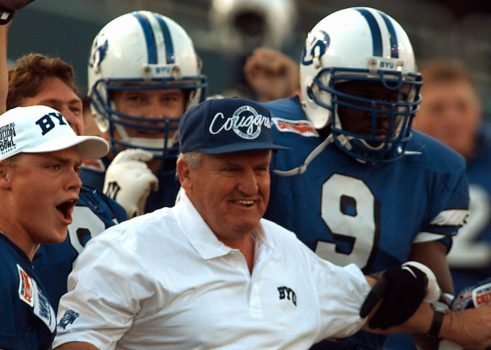
Brigham Young University has announced that the late LaVell Edwards, the most legendary person in BYU football history, would receive a distinguished posthumous award to commemorate a legacy that forever transformed the Cougars and reshaped collegiate football. The homage honors Edwards not only for his outstanding on-field accomplishments, but also for the heart, vision, and purpose with which he established one of the sport’s most distinctive and renowned programs.
LaVell Edwards’ contribution to BYU football is incalculable. When he took over the program in 1972, he brought a revolutionary offensive concept to college football, which was dominated by conservative, run-heavy tactics. Edwards believed in precision passing, quarterback empowerment, and clever preparation, all of which influenced the contemporary spread and pass-oriented schemes found across the sport today.
Under his leadership, BYU advanced from regional obscurity to national prominence. Edwards led the Cougars to 11 conference championships, 22 bowl berths, and the 1984 National Championship, the program’s first and only title. That championship season reinforced BYU’s national reputation and demonstrated that creativity, discipline, and belief could overcome old power systems in collegiate football.
But Edwards’ greatness went well beyond championships. He was well-known as a mentor, instructor, and developer of young men. His players frequently talk about a coach who trusted them, challenged them academically, and prepared them for life after football. Quarterbacks thrived under his tutelage, not only statistically but personally, with many moving on to successful careers in football and elsewhere.
BYU officials called the posthumous distinction as a tribute to “a coach who built more than a program—he built a culture.” That culture emphasized integrity, accountability, faith, and excellence, principles that still define BYU football decades after Edwards’ departure. His effect can still be seen in the program’s identity as well as the innumerable coaches and players who have been shaped by his beliefs.
As the Cougars prepare to publicly commemorate LaVell Edwards, the moment serves as a strong reminder of what long-term leadership looks like. He was more than just a great coach; he was a visionary who transformed the way the game is played and athletes are developed. LaVell Edwards’ legacy is a cornerstone of BYU football, built on heart, purpose, and a firm commitment in doing things the right way.